Updated September 8, 2026
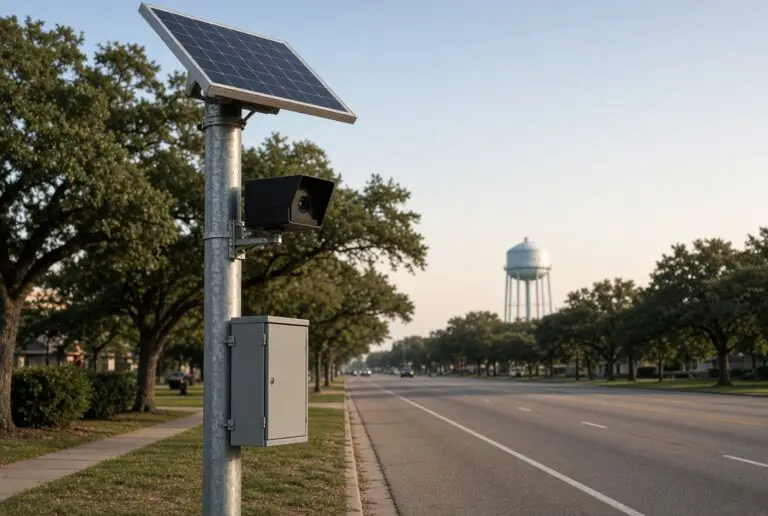
Flock cameras Texas cities are no longer a quiet procurement line. After Gov. Greg Abbott told state agencies to stop spending on the system, councils started voting in public. Independent tallies now put the pullback at roughly two dozen cities and counties that have cut ties, taken cameras offline, refused to renew, or frozen a grant-funded network. Your plate data still depends on which side of the city limit you drove through this morning.
That is the part a running “de-Flock” list usually leaves out. Ending a city contract does not wipe the statewide grid. Texas Department of Public Safety cameras on state right-of-way stay live. Neighbor cities can still share. Homeowner-association poles can still write the same trip. The useful question is not only who dropped Flock. It is who can still search the path your car took.
Why Flock cameras Texas cities split this fast
Three shocks stacked in August.
First, public-records reviews showed how wide the search net really is. Pflugerville’s council learned that hundreds of outside organizations had queried its cameras, with only a fraction holding formal agreements. That vote went unanimous. Cameras went dark the same night.
Second, misuse cases stopped being theoretical. A Lufkin officer was indicted on 100 felony counts of misuse of official information tied to Flock lookups of 11 people. The department suspended the whole system while Rangers and internal affairs investigated. Abbott cited the case when he described a statewide “crackdown.”
Third, the money moved. Abbott ordered state agencies to stop spending on Flock cameras after reporting that the Motor Vehicle Crime Prevention Authority had steered at least $30 million — much of it from a $1 auto-insurance fee sold as a catalytic-converter theft tool — into thousands of readers. Cities that built networks on those grants suddenly had a hole in the budget. Dallas is the largest example: 321 grant-backed cameras go dark September 15. More than 300 paid from other funds stay up.
Flock Safety says the cameras read plates and vehicle descriptions, not faces, and that new city partnerships still outpace cancellations nationally. Local fights in Texas are now about retention, third-party search, and whether a suburb can control a database it does not own.
Dropped, covered, or frozen
Status changes weekly. Treat this as a working ledger, not a statute. “Ended” means the city or county has terminated, declined renewal, covered, unplugged, or otherwise taken the municipal system offline or off the renewal path.
| Place | What happened | Status as of Sept. 8, 2026 |
|---|---|---|
| San Marcos | First major Texas city to cut national sharing, then dropped the contract | Off |
| Austin | Contract lapsed June 30, 2025; no city-owned Flock grid | Off (can still request peer data) |
| Hays County | Commissioners voted 3–2 in October 2025 to end contracts | Off |
| Hood County | Contract ended; constable covered and unplugged units | Off |
| Bandera | Council voted 3–2 in May to terminate | Off |
| Aransas Pass | Voted 4–1 in July to terminate | Off |
| Guadalupe County | Ended after vandalism made repairs cost more than staying | Off |
| Lago Vista | Unanimous Aug. 6 vote to remove | Off / being removed |
| Magnolia | Announced Aug. 11 it will not renew | Nonrenewal |
| Kendall County | Unanimous Aug. 25 vote not to renew (expires Sept. 30) | Nonrenewal |
| Pflugerville | Unanimous late-August vote; 28 cameras turned off | Off |
| Pflugerville ISD | Suspended cameras on district property after the city vote | Off |
| Wylie | Unanimous 7–0 vote; six cameras run until Oct. 13 | Nonrenewal |
| Robinson | Voted not to renew after a one-year trial; system deactivated | Off |
| Ingleside | Unanimous Aug. 11 vote to cancel grant-funded cameras | Ending |
| Manor | Police ended the relationship Sept. 3; about 10 cameras unplugged | Off |
| Elgin | Police suspended use pending elected officials | Frozen |
| Leander | Council directed a stop; 15 cameras taken down Sept. 4 | Off |
| Bastrop (city) | Council covered all 12 cameras; termination vote teed up | Covered / pending |
| Liberty Hill | Signaled it would end the program this week | Pending |
| Dallas | 321 state-grant cameras cancel Sept. 15; 300+ remain | Partial |
| El Paso PD | Halted state-funded readers after the funding pause | Frozen |
| Burnet County | Removed fixed cameras after vandalism; contract still runs to March 2027 | Offline, contract live |
| Lufkin | Department-wide suspension during criminal investigation | Frozen |
| Princeton | Grant cameras arrived; mayor is blocking deployment pending council | Not in use / pending |
| Sunset Valley | Reported as a nonrenewal; Flock portal still showed live readers in early September | Watch the expiration |
Independent reviews in early September counted about 18 cities and five counties in some form of pullback — more than a drop-only snapshot once partial freezes are included.
Still scanning
This is the half of the map a drop-only list hides.
Central Texas agencies still on the network
According to KUT’s Sept. 8 roster: Hutto, Bastrop County Sheriff, Taylor, Kyle, Buda, Lakeway, Cedar Park, and Round Rock. Georgetown has plans but had not stood up cameras. Bastrop city police were moving to exit even as the county sheriff stayed on.
Round Rock is the Austin-orbit heavyweight. Its 43 readers logged more than 676,000 vehicles in a month and shared data with 1,453 agencies, more than half of them outside Texas, according to the department’s own Flock transparency portal. City leaders said they had no plan to stop unless council directed them to.
Harris County
Harris County still shows the densest community-mapped cluster in the state. Commissioners renewed a nearly $869,000 Flock contract through June 5, 2027, after residents pressed on outside-agency access. Mapped ALPR counts in the Houston area run into the thousands when city, county, HOA, and school-district poles are counted together.
Tarrant County
Tarrant County is staying. Sheriff Bill Waybourn told commissioners the cameras are among the best tools his office has, citing recovered stolen vehicles and major-case leads. The sheriff’s office itself owns only a handful of poles; hundreds more in the county sit with cities and private operators. Data retention there is 30 days unless a case holds it longer.
League City
League City put the question on the Nov. 3 ballot — a nonbinding advisory vote on whether police should keep fixed automated plate readers on public roads. The city operates 55 Flock cameras, with more in permitting. Council keeps the final say.
Texas DPS
Texas DPS is the statewide overlay. Abbott’s order paused new state spending and new installs. Existing DPS readers on state-owned roads, including in Austin after the city dropped its own contract, remain in use. After questions about thousands of agencies searching without signed agreements, DPS said it would limit full search access to agencies that have those agreements. The Texas Tribune reported that case-by-case sharing with departments such as Austin PD can still happen.
What the cameras actually capture
City briefings are consistent on one point: these boxes are built to read plates and vehicle attributes (make, model, color, distinguishing marks), not faces. Flock’s public policy language says the system does not use facial recognition.
The fight is over the log, not the lens.
- Retention. Many Texas contracts default to 30 days. Some cities negotiated seven. DPS policy has allowed much longer retention on its own network.
- Search rules. Departments often require a case number or a stated reason. Audits in Austin and elsewhere found incomplete logging. The Lufkin indictment alleges lookups labeled only “investigation.”
- Sharing. A city can own the pole and still sit inside a national lookup. Pflugerville’s records and Round Rock’s portal are the two clearest local windows into how far a plate can travel.
- Ownership of the image. When a city ends a contract, Flock’s stated off-boarding process is to disable platform access, remotely deactivate cameras, then schedule physical removal. Historical searches already run by other agencies are a separate question.
If your city shares widely, an agency you never heard of can pull your car’s path. If your city dropped Flock cameras, Texas cities next door may still be writing the same trip.
Central Texas: the sharpest split
Austin ended its contract in 2025 after an audit and a fight over immigration-related sharing. That did not end plate reads on Austin streets. DPS later installed readers on state right-of-way inside the city. Neighbor agencies kept their own grids. APD has said it does not have direct Flock-database access but can request help from peer departments in joint investigations.
Then the suburbs broke.
Pflugerville’s vote became the template: public-trust language, cameras covered or powered down immediately, school district following the city. San Marcos and Lago Vista had already moved. In one week in early September, Manor, Elgin, Bastrop, and Leander joined them. Leander crews pulled 15 cameras the day after a packed hearing. Manor’s chief said the department still saw investigative value — and still chose community trust.
Round Rock, Cedar Park, Kyle, Buda, Hutto, Taylor, Lakeway, and the Bastrop County Sheriff did not follow. That is why a drive from Austin to Round Rock is not one privacy regime. It is two.
North Texas: Dallas keeps half the net
Dallas is the biggest partial retreat. Police said 321 state-funded cameras go dark September 15 after the grant died. The department still claims more than 300 live readers and calls them a daily investigative tool. Council has already rejected at least one budget move to kill the remaining city-funded share. Watch the next budget amendment cycle.
Wylie’s six cameras die when the contract expires October 13. Princeton’s grant cameras arrived just as the mayor asked council not to switch them on. Hood County is off. Tarrant County’s sheriff is still making the crime-fighting case in public. That is the North Texas pattern: small cities peeling off, large agencies defending the tool, and state money no longer filling the gap.
Houston region: density plus a ballot
Harris County’s mapped cluster remains the thickest in Texas. The county renewal through mid-2027 means the sheriff’s network is not in the same emergency as grant-only cities. League City is the first large Houston-area city to put Flock on a general-election ballot, even if the proposition is advisory. Conroe residents have pushed a similar fight. If you want a statewide signal after Abbott’s pause, November 3 in League City is the next numbered date that matters.
What happens to your plate this month
- If you stayed inside a dropped city such as Pflugerville, Leander, or Manor, the municipal poles should be dark. DPS or a neighbor city can still see you on the connecting road.
- If you crossed into Round Rock, Cedar Park, Kyle, Harris County, or live Tarrant County routes, assume the scan still writes.
- If you drove Dallas, assume a mixed grid after September 15: fewer poles, not zero.
- If another agency already searched your plate during the 30-day (or longer) window, ending the local contract does not recall that query.
- Private and HOA cameras are not on city council agendas. Several Texas towns learned that the hard way when residents mapped poles the city did not buy.
How to check your own city tonight
- Search the next city council or commissioners-court agenda for “Flock,” “ALPR,” or “license plate.”
- Look for a Flock “transparency portal” under your police department’s name. Round Rock’s is the model for volume and sharing counts.
- Separate city police, county sheriff, DPS, and HOA systems. One “no” does not bind the other three.
- If your city is on a nonrenewal clock (Wylie, Kendall County, Magnolia), read the expiration date. Nonrenewal is not always immediate dark.
Watch this week’s council agendas. Pair local votes with the statewide race in our Texas Senate explainer and the current Texas Senate roster.
FAQ: Flock cameras Texas cities
Did Abbott ban Flock cameras in Texas?
No. He froze state-agency spending on them. Cities can still pay with local or federal money. DPS said it will keep using cameras already in the ground.
Do Flock cameras Texas cities use facial recognition?
Official briefings and Flock policy say no. The stored record is plate, vehicle description, time, and location.
If my city dropped the contract, is my data gone?
New captures from those city cameras should stop. Prior retention windows and searches by other agencies are not automatically erased. DPS and neighboring cities can still collect on their own poles.
Why do some cities keep them?
Police associations and sheriffs cite stolen-car recoveries, missing-person alerts, and faster suspect identification. Tarrant County and Dallas PD have put those claims on the record while smaller councils have decided the trust cost is higher.
What should I watch next?
Dallas cameras on September 15. Bastrop’s formal termination vote. Liberty Hill’s promised exit. League City’s November 3 advisory ballot. Any 90th Legislature bill in 2027 on warrants, retention, and out-of-state search.
Status notes in this article were compiled from city and police statements, council votes, and reporting current as of September 8, 2026. Local agendas can move faster than a published list.